What role does IT play at aquaRömer?
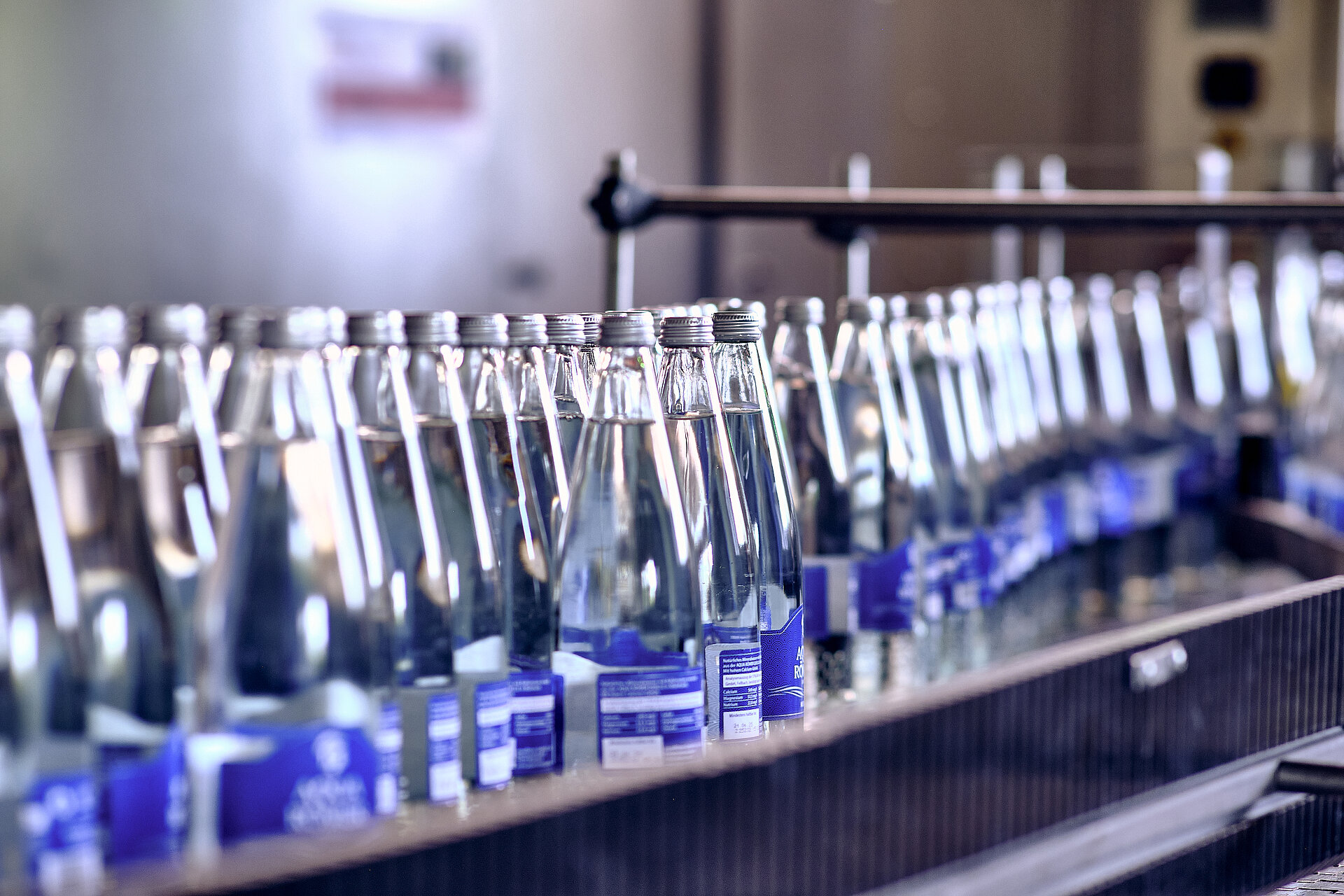
Dominik Schmidt: Behind the bottling lines of our family business lies a highly automated IT landscape. Every system is interconnected, from spring monitoring to quality control and batch documentation. If one of them fails, key records are missing and production comes to a standstill. Not because a machine is broken, but because mandatory checks can no longer be documented. The availability of our IT systems is therefore essential if we want to produce without interruption. aquaRömer’s IT department is lean. Responsibility lies with a single employee, supported by an external service provider.
How would you describe IT security at your company?
Dominik Schmidt: Security requirements have risen steadily over the past few years. Besides regular office workstations, we also have to protect systems close to production. On top of that come regulatory requirements from the food industry. Until now, we lacked the resources to analyze security alerts promptly, especially outside regular working hours. That’s why we wanted to further improve our IT security. What we don’t need, though, is software that just generates alerts. What actually helps us is a combination of a modern security solution and a service that detects threats, assesses them and handles them by priority.
What requirements did the new security solution have to meet?
Dominik Schmidt: Several requirements were front and center. One was round-the-clock monitoring of security-relevant events to protect both office and production systems. We also wanted simple administration and a clear management console to ease the burden on our internal IT. Reliable help in an emergency was on the agenda during the selection process as well. In addition, the vendor needed a German or European background in order to meet strict data protection requirements. That last point had recently become more important to us. The shifting geopolitical situation has made us much more attentive to where IT security vendors come from.
What did the selection process look like in practice?
Dominik Schmidt: We started our search independently of our existing service providers. We looked specifically for European alternatives and came across G DATA CyberDefense, based in Bochum. In the end, the decision came down to two solutions: the security platform from an international vendor that we were already using, and G DATA MXDR.
Which solution did you choose? And why?
Dominik Schmidt: We chose G DATA MXDR. The deciding factors were ultimately the German location and the close collaboration with the analyst team. That means we opted for a vendor that brings together development, operations and security expertise in Germany. Incidentally, the switch was a deliberate decision, made independently of the IT service provider that supports us. This allowed us to build additional expertise in-house and strengthen our own ability to act.
How did the rollout of the new solution go?
Dominik Schmidt: I’ve rarely seen such a smooth rollout of an extensive IT system. Despite our complex IT landscape, the switch was surprisingly straightforward. Onboarding was done entirely remotely and wrapped up after just a few joint sessions. The installation required hardly any exclusion rules. And no adjustments have been needed in day-to-day operations either.
What has your experience with G DATA MXDR been like in day-to-day operations?
Dominik Schmidt: Today, G DATA protects around 80 systems at aquaRömer, from office workstations and servers to production-related systems in bottling. What stands out is how well the solution works in practice. G DATA’s MXDR team continuously monitors security-relevant events and assesses them with real expertise. Instead of checking every alert myself, I receive incidents that have already been classified, because the analyst team has already responded. As a result, many events drop off my daily to-do list before any action is even needed. That noticeably eases the load on our internal resources. When several alerts come in and the last one is already marked as resolved, I know the issue is in good hands. So far, I’ve only had to step in myself in a handful of cases.
Have you received any feedback from employees?
Dominik Schmidt: For most employees, nothing has changed, because the rollout went largely unnoticed. Despite the rigorous security approach, there are no restrictions in their daily work. Only in isolated cases did we have to take a closer look at specialized software from the production environment. This means G DATA MXDR meets one of aquaRömer’s key requirements: security should protect without slowing down work processes.
How would you rate the collaboration with G DATA?
Dominik Schmidt: It’s pragmatic, uncomplicated and solution-oriented. Even during the rollout, I was impressed by the short lines of communication and the clear support from the onboarding team. What I value most is the combination of having a person I can reach directly and G DATA’s analysts working through issues on their own. For me and for aquaRömer, that means one thing above all: more time for our core business. The solution definitely takes pressure off us. In a small IT department in particular, that makes a real difference.
What’s your overall verdict?
Dominik Schmidt: Modern IT security isn’t just a matter for large companies. With external experts on board, I can focus on projects and day-to-day operations while security-relevant events are monitored around the clock. Especially in mid-sized manufacturing companies with small IT teams, availability, fast response times and reliable support are crucial.während sicherheitsrelevante Ereignisse rund um die Uhr überwacht werden. Gerade in mittelständischen Produktionsbetrieben mit kleinen IT-Teams sind Verfügbarkeit, schnelle Reaktionszeiten und verlässliche Unterstützung entscheidend.
Thank you for talking to us.
Abouot aquaRömer
aquaRömer GmbH & Co. KG is a family business from Baden-Württemberg with a long tradition. For more than 180 years, aquaRömer has produced and distributed mineral water, medicinal water and non-alcoholic soft drinks, and it ranks among the leading mineral spring companies in southern Germany. Headquartered in the Schwäbisch Hall district, the family-run company employs around 120 people and fills some 130 million bottles every year.